
A Loose Nut and a Lawyer
societyeconomicsculture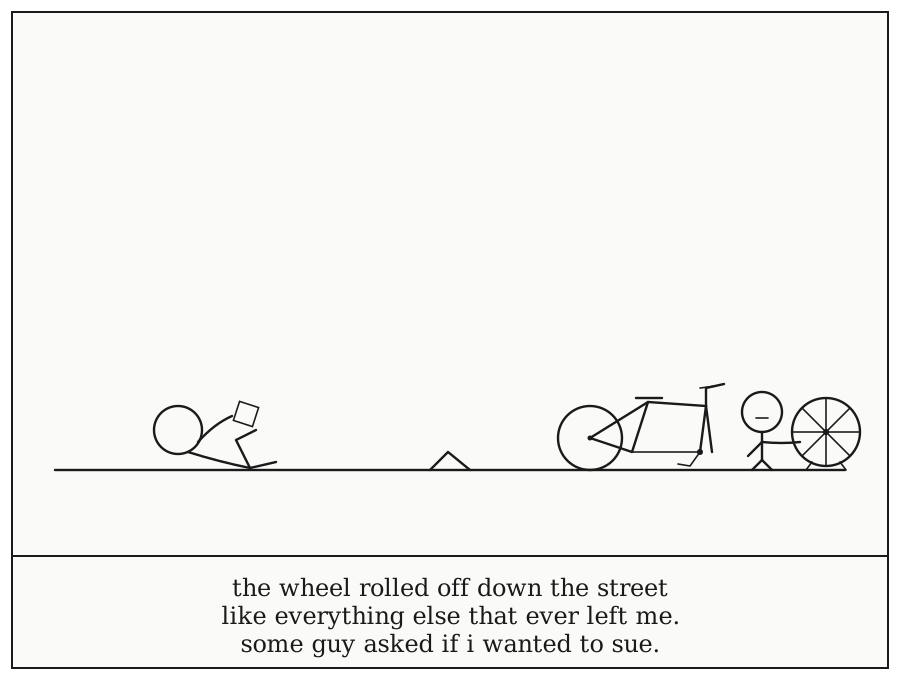
The country sells young men two exits now, and both require something to go wrong.
I was listening to the Tim Dillon podcast when the ad break came on, announcing itself as Morgan & Morgan. Look at where they put it. Nobody who paid for that slot did so idly. Tim Dillon's audience isn't made up of the productively occupied. It consists of men in cars, men on job sites, and men who have decided that the whole system is a joke and are laughing along with the comedian who agrees. That's the crowd. The slot given to it, right in the middle of the show, belongs to the largest injury law firm in America. This isn't sponsorship; it's prospecting.
Why I was watching the ads
I should say up front that I have been listening to podcasts for twenty-two years, since 2004, the year the word was coined. At the time I was living in Manhattan and out of work, walking the city in a low-grade panic looking for a job. The closest thing to a podcast I could find was Ricky Gervais, who had a show on a London radio station called XFM. I would download the MP3 files, load them onto an iPod, and walk around listening to three Englishmen insult each other while I failed to find employment. It helped.
So I have watched the medium the entire way up, from a man ripping audio files off a website to an industry handing out nine-figure deals. And for reasons I can't entirely defend, the part I always watched was the business model. How was any of this supposed to pay for itself? The answer was always in the advertising, so the advertising was what I paid attention to.
It has a history of its own. In the early years the ads sold things I'd rather not describe, the products you take when no respectable brand will be seen with you. Then came the supplement era: Joe Rogan, Alpha Brain, a whole demographic persuaded that a capsule would hand them their focus back. For a long time that was the ceiling. Podcast advertising meant things you were slightly embarrassed to be sold, and the embarrassment was half the joke.
Which is why Morgan & Morgan broke the pattern. A few months ago the largest injury law firm in America started turning up in the slots that used to hold the nootropics, and it did not read as a step up in respectability. It read as a warning. These are shows built for young men and women, a lot of whom have concluded the future isn't coming for them, and somebody in a marketing department had looked at precisely that audience and seen a target. I work in corporate innovation. I can tell clever from sinister, and this was the second one. So I started looking, and the firm was not hard to find.
The firm was attached to Dave Portnoy's pizza review too. I also learned that it is the official law firm of the WWE, a phrase I'd be accused of making up if it weren't linked to a real WrestleMania sweepstakes. There's no way to arrange those words that isn't funny. There's also no arrangement that could possibly be an accident. In 2018, the firm spent around $130 million on advertising. Projections for 2026 estimate their marketing budget will be between $500 and $600 million. John Morgan has said, on a podcast, that he puts in $400 million and pulls out $5 billion. He called it an asset class with a reliable return. The troubling part is that he's not lying. Half a billion dollars a year, returning twelve to one, is an engine. And an engine needs fuel, and that fuel is people who have been hurt and don't yet know they are plaintiffs. So the buy isn't random. You don't spend that much to reach the satisfied. You spend it to reach the man who is just one bad day away from picking up the phone.
The same ad break, a different product
Here's the observation that got me writing. The slot next to Morgan & Morgan, in the same podcasts, aimed at the same man in the same car, has been given to the prediction markets. Kalshi cleared about $31 billion in notional volume in June, with roughly 85 percent being sports-related. Three million new accounts opened during the World Cup. This year, around $32 million went to national television, some of it during live matches, and they even hired Timothée Chalamet to read the promos. This spending shows that their customer acquisition math is working just as well as the law firm's.
To be fair, prediction markets are a legitimate tool. Their creators can make a respectable case for the aggregation of information. But that argument doesn't explain what $31 billion a month really means. When five out of six parts of your business are sports, and the whole setup lives on a phone next to a comedy podcast, you're not running a forecasting service. You're running a bookmaker's shop that has better legal advice. The closeness of the two ads isn't a coincidence; they're selling the same thing. Not a lawsuit and not a bet. A claim check. A slip of paper that says the windfall might, possibly, be yours. Both target men who have quietly stopped believing that success comes from hard work. They both perform the same trick: turning a bad day into a ticket.
Why the pitch lands
To understand why it resonates, we need to be honest about what it isn't. It isn't stupidity, and the gullible aren't the issue. The instruction is. The white-collar path has stopped being a path. Everyone knows the graduate with debt and a job that requires neither. This story has been told so often that it's gone from warning to genre. So the advice became: enter the trades. I like the trades. I'm a certified bike mechanic, a hobbyist rather than a professional. I got certified because I wanted to fix my own machines and understand what I was doing. Working with your hands is a good way to spend a life. But notice who is now buying that life.
Apollo invested about $2 billion into Apex Service Partners, which is valued at nearly $10 billion. Apex has consolidated around 107 brands. Wrench Group operates 25 brands across 14 states with 7,300 employees. Blackstone bought Champions Group for about $2.5 billion. The plan is clear, and no one seems embarrassed: buy the small shop at five to seven times earnings, merge the shops, and sell the whole thing for seventeen times earnings. This means the very thing sold to a nineteen-year-old as the last honest ladder in the country is now being bought by asset managers who believe it can be standardized, staffed, and squeezed for profit. The man who owned the shop gets his check. The man who reports in year six inherits a route-density target and a uniform. Call it not a conspiracy but a law of nature: what happens to any fragmented trade with recurring revenue once capital comes looking for a home.
So the young man receives, from all sides, the same message: the slow door is closing, and the fast door is advertised on his favorite show.
The wheel
I was in a bad accident not long ago. I suffered a head injury. I'm okay now. Within a week, three different people asked if I planned to sue. Not hesitantly, not as a delicate suggestion. Cheerfully. As casually as asking if taxes have been filed. Here's the whole matter: the wheel came off my bicycle while I was riding it. I'm the one who works on that bicycle: certified, self-taught in the details, serious about my hobby. I took the bike as it was and failed to tighten the nut. It was my responsibility to tighten it. There's no defendant here. There's a man who should have checked his own wheel, and I know him well. I don't sue. I don't claim this makes me better than anyone else. Where there is real negligence, I believe the courts exist for a reason and should be used. I just find the reflex vulgar in a way I struggle to explain. It's the eagerness that offends me, the speed with which injury is assessed, priced, and put up for sale.
Yet the three who asked weren't ghouls. They were moderns. They had absorbed half a billion dollars a year of lessons in the belief that an injury is an asset and that anyone who doesn't cash in on it is a fool. They were, in their way, looking out for me. That's when I realized what the advertising is really building. Not a caseload. A worldview, one that will likely outlast whatever marketing team is currently spreading it. There will be a generation of men who look at their lives and see only two exits: the settlement and the gamble. Both require something bad to happen. Neither requires a man to be good at anything. That's the part I can't shake. It's not that men gamble; they always have. It's that we've created a massive, well-funded, professionally run system that teaches the young that their only hope comes from accidents. They've taught a generation to hope for the crash.
The boys
I should admit my interest, since I've been asking for honesty from everyone else. I have three children, two of whom are boys, and they'll be teenagers in just a few years. So none of this is just academic for me. What will they think when this system turns its focus on them? Which career path should a father suggest to his sons? The trades will be overcrowded by the time they get there: wages will be low, and the ladder will have been bought and sold twice over, with private equity doing what it does best, which is making everything worse for everyone except itself. White-collar work will be interesting, in the way the old curse suggests. My sons will still have to make a living somewhere inside it.
The strange part is that there's no edge to it, nowhere it isn't. You can't move your family out of its way; it follows you. It's the Nothing from The Neverending Story, eating everything from every direction at once. I have no solution, and I'd distrust anyone who claims to. Likely dark times ahead. Wear a helmet.