
The New Poor Have Graduate Degrees
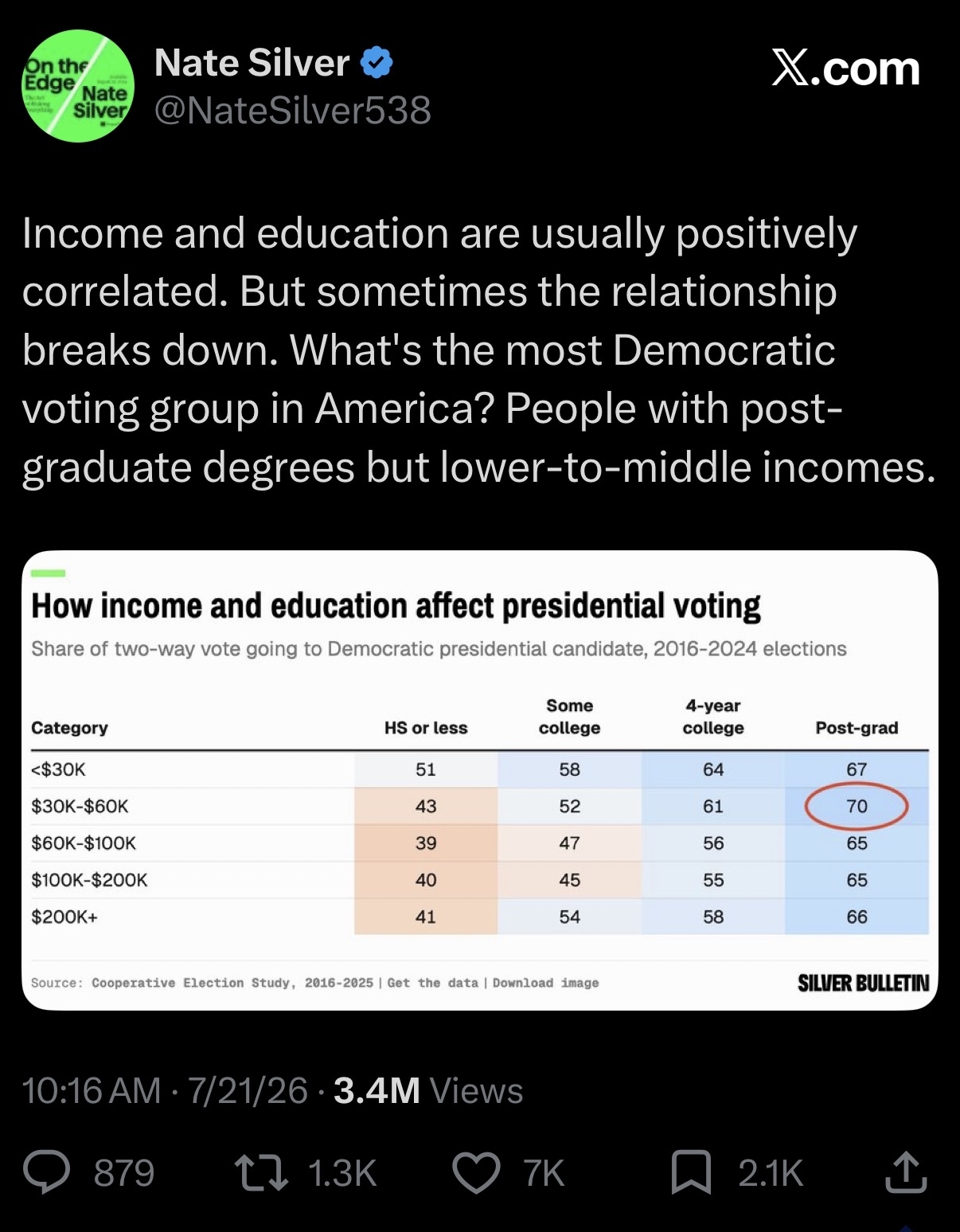
AIeconomicssocietyA chart went by yesterday and lodged itself: the Democratic coalition sorted by education and income. The group that stood out (the most reliable voters, the most likely to donate and campaign) wasn't the rich or the poor. It was people with graduate degrees who earn very little. The most schooled, least paid square on the board is where the dynamite is stored.
Anyone who's read Eric Hoffer just felt the temperature drop.
Hoffer wrote The True Believer in 1951 while working as a longshoreman. He educated himself in public libraries between shifts. His argument is that revolutions aren't made by the poor. Those struggling to survive are too focused on staying alive to nurture grievances or envision alternatives. The real threat comes from the new poor: people who remember having something, or who were promised something and can still taste it. Deprivation isn't measured against nothing; it's measured against expectation.
Then there's the second part of the insight, the part that gets quoted less. Mass movements don't start in the streets. They begin with what Hoffer called the men of words: the educated, articulate, and credentialed who believe they deserve a place at the table and find it full. A frustrated intellectual isn't primarily hungry; he feels unrecognized. Offer him status and he becomes a pillar of the establishment he was about to burn down. Withhold it, and he writes the pamphlet that brings down the regime.
Now take another look at that chart.
I am part of the problem, which I would rather admit than have pointed out
I don't use programmers anymore. I used to. I don't hire a designer or a proofreader. I do all of it in an afternoon with an AI sitting in the chair where four people used to sit.
I'm not bragging. I'm confessing, because I'm about to describe a flood, and it would be dishonest to do that while pretending I'm not one of the raindrops.
Multiply me by a few million small operators, agencies, founders, and mid-sized companies quietly not filling roles, and you get the next decade. Notice that the jobs disappearing first aren't the hardest ones. They're the most legible. Anything that can be handed over as a deliverable: the memo, the mockup, the spec, the research summary, the first draft, the deck. In other words, the entire prize at the end of the credential ladder.
That was the deal. Do well in school. Do well in college. Get the degree, then the graduate degree, and you'll be paid to work with your mind instead of your back. Nobody mentioned that "work with your mind" would turn out to mean "produce text and images a machine can now generate in nine seconds for a fraction of a cent."
Meanwhile nothing has changed for the guy who fixes my HVAC. His work is stubbornly local, physical, and resistant to being turned into tokens. People who work with atoms will out-earn people who work with bits, and the crossover will arrive faster than anyone's ready to admit. A robot that can crawl into a 1958 crawlspace, find the fault, and improvise a fix with what's in the truck is a great deal further off than a program that can write a competent brand strategy.
I want to be careful here, because "learn a trade" has curdled into a smug punchline and I want no part of that. The trades are a better bet than they were, but they're not paradise. Flood a field with entrants and wages compress. The body is a depreciating asset; knees and backs keep their own books. Nobody who has actually done it romanticizes it. Better bet, not rescue.
The part that worries me
It's not the unemployment. Economies have absorbed technological shocks before, and the people who predicted permanent mass idleness have a long and unimpressive record.
What worries me is the specific psychological makeup of the people this one will hit.
They are verbal. They are organized. They are extremely online. They've spent six to ten years honing the exact skills mass movements run on: framing, argumentation, moral vocabulary, the ability to make a grievance sound like a principle and a principle sound like an emergency. And many of them are about to have, for the first time since they were nineteen, a great deal of unstructured time.
Hoffer's other claim (the uncomfortable one) is that true believers are interchangeable. The doctrine matters less than the relief of dissolving into something larger. A sufficiently frustrated person joins whichever movement is accepting applications that week. So I wouldn't assume this energy stays inside the Democratic Party, or on the left at all. Frustration is ideologically promiscuous. It goes where it's flattered.
And here's what makes this sadder than it is contemptible, and why I refuse to write the smirking version: they weren't wrong. They did what they were told, in the order they were told to do it. The deal was real when they signed it. Society spent forty years insisting the path to a decent life ran through the university, priced that path at the cost of a house, and then, just as the last cohort started paying it down, quietly automated the destination.
That's not a personal failure. That's a breach of contract by a counterparty too diffuse to sue.
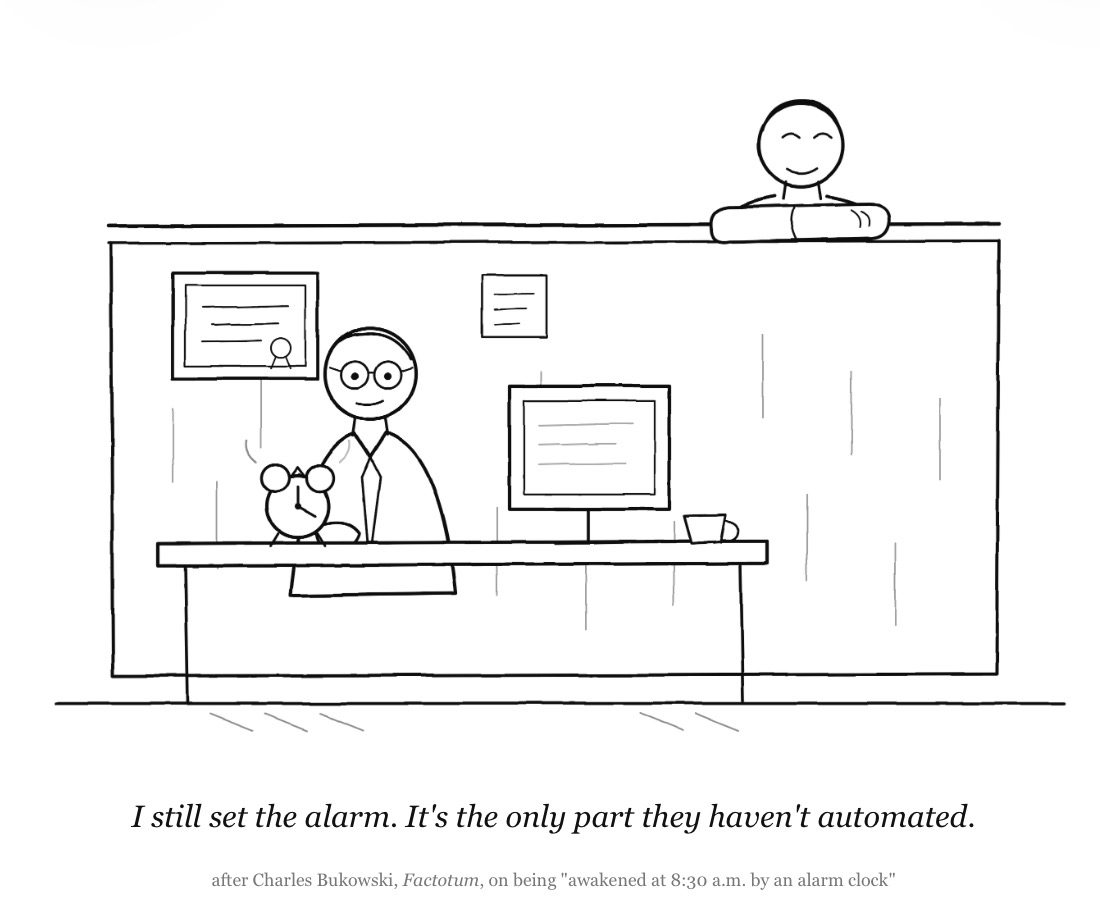
So anger is coming, and it will be articulate. I don't think a retraining program or a podcast about resilience is going to absorb it. Hoffer, who educated himself while everyone else was collecting degrees, understood something about a clever man that the world keeps forgetting.
The most combustible figure in any society isn't the hungry one. It's the one with a diploma on the wall, time on his hands, and a persuasive story about why none of it is his fault.
The trouble is that the story is true.
I recommend getting a second passport and wearing a helmet.