
Wet Asphalt
filmfamilyaddictionphotographyTwenty years of photographing cities at night, and the only technical requirement is that you don't leave.
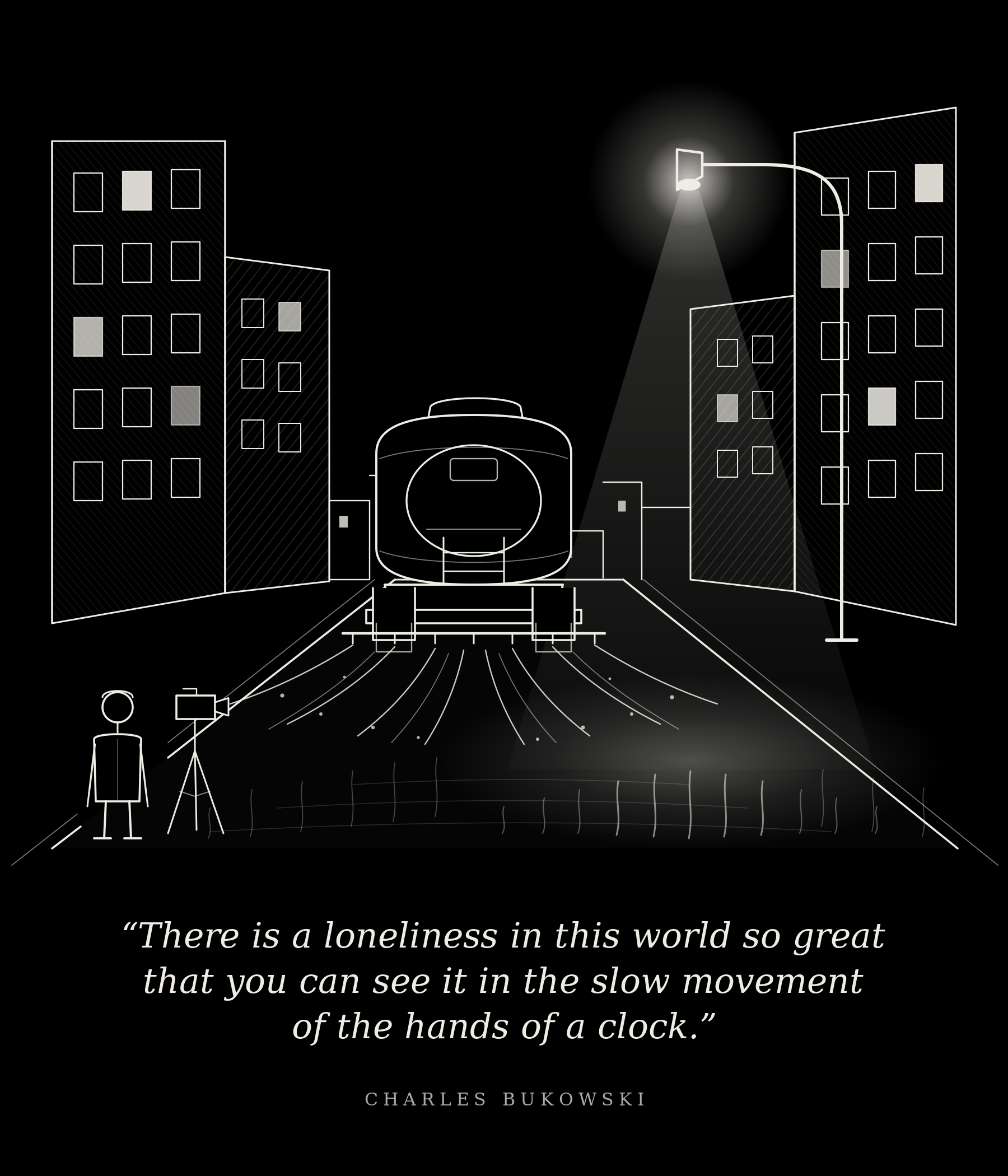
Director Michael Mann famously kept a water truck on his film and television sets to constantly spray down asphalt and city streets for night shoots. He did it because dry asphalt does not hold light and wet asphalt does. He flooded streets in a desert city so that a sodium lamp would have something to land on.
I think about that more than I think about most things that have actually happened to me.
I have been photographing cities at night for twenty years. Tripod, cable release, long exposures, the whole tedious liturgy. I go out at eleven, midnight, one, and I stand very still in parking structures and on overpasses and in the loading zones behind buildings where nobody is, and I try to get something I have never once gotten. I know what it is. It is a thing a man put on film in 1981 and again in 1995, and I have spent two decades and a considerable amount of money trying to reproduce it with a tripod and no water truck.
I have told people it's a hobby. It is not a hobby. Nobody does a hobby for twenty years alone in the dark.
Here is my father's résumé.
Undergraduate degree in microbiology. Master's in genetics. Self-taught programmer, Pascal and FORTRAN, out of books and tapes, at night, in the nineteen seventies, for no reason except that he had decided he was going to know how. Wanted to be a doctor. Did not become one. Finished first in his class at Quantico. Special agent, Drug Enforcement Administration.
Two marriages. Two children.
Twelve rehabs. Dead at forty. Alcohol and drugs.
What I remember are the tapes.
Betamax, I think, though I was small enough that everything black and rectangular was the same object to me. They sat on a shelf in the room where he worked, and they had handwritten labels, and one of them said PASCAL. I did not know it was a language. I thought it was a man's name. I thought Pascal was somebody my father knew.
I have never been able to work out whether those tapes were lessons or the programs themselves, and there is no one left to ask.
What I understood was that he went into that room and came out knowing something he had not known when he went in, and that this was apparently a thing a person could do to himself. I have never gotten over it. I have never in my life wanted anything the way that man wanted to know things.
He was in his thirties in that room. He had maybe six years left.
The Insider is the one nobody expects you to bring up. It's the Mann film with no guns in it, the one people file under Serious Oscar Movie and skip on the rewatch. It is also, as far as I can tell, my father's biography.
Jeffrey Wigand is a scientist. Biochemistry. A man who went into the sciences to make people healthier and who ends up employed by Brown and Williamson, engineering the delivery mechanism of the thing that kills them. He is a man of medicine standing on the wrong side of the poison, and Mann is very careful to show you that he is good at the job. That's the part that gets me. Mann never lets Wigand be a martyr who wandered in by accident. He's an expert. The expertise is the whole problem.
My father wanted to be a doctor. He had the microbiology and he had the genetics and he did not get the medical degree, and what he became instead was a federal narcotics agent, which is to say a man of medicine standing on the wrong side of the drug. He was extremely good at it. First in his class. He knew more about what those compounds did to a human body than almost anyone who would ever arrest him.
It killed him anyway. Being right is not protective. Mann has been making that argument his entire career and nobody wants to hear it, because it's a horrible thing to be told. You can be the best one in the room and lose. You can be first in your class at Quantico and be dead by forty.
Watch what happens to Wigand across that film. The job goes. The house goes. The wife goes. The last third of the movie is a brilliant man sitting alone in a hotel room in Louisville waiting for a phone to ring. Mann shoots that isolation the way other directors shoot violence, slowly and with total attention.
The difference, and I am not going to pretend otherwise, is that Wigand's isolation was done to him and my father's came from inside. Nobody sent a threat to our house. There was no tobacco company. The thing that stripped him down to a hotel room was in his own blood, and my mother was the first one to find that out, and the two of us were next, and there was a second wife after us who got whatever was left.
Something I only noticed after about the fifteenth rewatch: Michael Mann's men do not have fathers.
They arrive fully assembled. Neil McCauley has no parents, no hometown, no explanation. Vincent Hanna has three marriages and no childhood. Frank in Thief is the exception that proves it, and his origin story is a state institution, which is to say he was raised by a building. These are men brought up by systems rather than by anybody, carrying a code around like a wound they're managing.
My grandfather walked out on my father. My father died on me when I was ten, which is a different mechanism and the identical hole.
That is three men in a row now, and I have three kids.
Everyone quotes the coffee shop scene, and everyone is right to, but they usually quote it wrong. It gets treated as a face-off between two great actors, cop and criminal, hunter and hunted. It isn't a face-off. It's two men admitting to each other that the discipline that makes them extraordinary has cost them the same things, and that neither one of them can stop.
I don't need two actors for that scene. I have it in one body.
Eighty-five percent of the time I am, by any external measure, doing well. I am extremely good at my job. I have a lot of friends. I show up. I am, I'm told, good company.
Fifteen percent of the time I am reckless, thoughtless, mean, and profoundly self-destructive.
Almost nobody sees the fifteen. The people who see it are, without exception, the people who love me, which is not a coincidence and is not an accident of proximity. It is the arrangement. The public competence is real and the private wreckage is real and they are not two men, they are one, and the only ones who ever get to meet the second one are the ones who signed up to stay.
Mann knows exactly what that arrangement costs, and he films the bill. Vincent Hanna's stepdaughter Lauren opens her wrists in his hotel bathroom. He finds her, carries her out, gets her to the ambulance, and then he leaves. He hands the child off and goes to make the arrest, because there's a man out there he has to catch, and that is who he is, and Mann does not editorialize about it for a single frame. He just shows you the man leaving.
It is the most unforgiving thing Michael Mann ever filmed about being a father, and it took me about eighteen years and one rehab to understand that it was the scene I had been circling the whole time.
Then there's the line. Everybody knows the line. Don't let yourself get attached to anything you are not willing to walk out on in thirty seconds flat if you feel the heat around the corner.
It sounds like freedom. It's a suicide note. Mann understands this perfectly and kills McCauley for it in the last reel, on a runway, alone, holding a hand he only reached for once he'd run out of exits. A man with nothing he can't walk away from is a man with nothing worth staying alive for. That is the actual content of the thirty seconds rule and it is why the movie ends the way it ends.
My father lived by it. I doubt he'd have put it that way. But two marriages walked out of and two children left behind is the rule in practice, and the heat was always around the corner, and it always came from the same direction, and he never once got clear of it.
I did the opposite on purpose. Three kids. A marriage. Friends who have seen the fifteen percent and stayed anyway, which I still don't fully understand. A week inside. Sixteen weeks of dual diagnosis outpatient. All of it deliberately, expensively attached, all of it impossible to walk out on in thirty seconds or thirty years.
My father went to rehab twelve times. One of them was Betty Ford. I have been once.
The weight is the point. The weight is the only counterargument to the entire filmography.
The Insider does not end in triumph and I've always been grateful for that. It ends with Wigand in a classroom, teaching high school chemistry in Kentucky, standing in front of a room of teenagers with almost nothing left of the life he had. It is not a victory. It's a man who lost the house and the marriage and the career, kept the science, and handed it to children.
My father never got that scene. He got a hotel room, more or less, at forty.
I go out at night with a tripod, and here's the thing about a long exposure that took me twenty years to hear: it only works if you don't move. The shutter opens and stays open and the light accumulates, slowly, off wet asphalt and sodium lamps and the windows of buildings where somebody is still working, and the only requirement, the entire technical demand of the format, is that you stand in one place in the dark and do not leave.
I have been practicing that for twenty years. I told myself I was taking pictures.